




A bill built on broad support
The bill passed the Senate 27-7 and received unanimous support on the House floor. Sponsored by Sen. Matt Ball (D-Denver), with bipartisan co-prime sponsors including Rep. Ryan Gonzalez (R), SB 142 attracted 29 sponsors across both chambers. The bill cuts red tape, unlocks local government authority to develop geothermal projects, scales up community geothermal gardens, and directs the state to begin collecting the resource data Colorado will need to plan its geothermal future. InnerSpace Action helped make that happen.
“Colorado is set up really well for geothermal energy,” said Sen. Ball. The bill reflects that confidence — and the result of months of careful stakeholder engagement to bring Xcel Energy, major environmental groups, municipalities, and others to the table in support.
What SB 142 does
The bill focuses on cutting soft costs, clearing legal ambiguity, and creating durable policy signals that geothermal electricity, industrial heat, and building heating and cooling should be part of Colorado’s future. Taken together, these provisions are expected to lower development costs and accelerate projects across every tier of geothermal development.
The key provisions:
- Utility engagement made mandatory: Requires investor-owned utilities to solicit proposals for geothermal projects, sets a 300 MW target for large-scale solicitations, and mandates PUC action within 120 days, making utility engagement with geothermal a requirement rather than an option.
- Local government authority: Authorizes municipalities, counties, and special districts to enter thermal energy network agreements up to 25 years, issue revenue bonds, and partner with private entities for geothermal development. That 25-year term matters enormously: it aligns with the financing horizon for this kind of infrastructure, making projects bondable and bankable for the first time under Colorado law. Local governments developing thermal energy networks will not be treated as public utilities.
- Expanded geothermal gardens: Increases community geothermal garden size limits from 5 MW to 25 MW and requires utilities to purchase their electricity, opening a meaningful new pathway for distributed geothermal generation.
- Removed barriers for municipalities: Removes procedural hurdles that had slowed local action to build TENs.
- State resource data collection: Directs the Colorado Energy and Carbon Management Commission and Colorado Geological Survey to collect geothermal resource data and report policy recommendations to the legislature by November 2026, with an explicit protection ensuring oil and gas operators cannot be required to participate in data collection as a condition of permitting approval.
- Clean heat integration: Emissions reductions from qualifying thermal energy networks count toward a utility’s clean heat plan obligations, even if the utility does not own or operate the network.
The core insight behind the bill is straightforward. Colorado has already invested more than $45 million through grants and tax credits to get thermal energy networks off the ground. Those projects are now reaching the contracting stage. What has held them back is not the engineering and not the economics — it is legal uncertainty. SB 142 eliminates it, at no fiscal cost to the state.
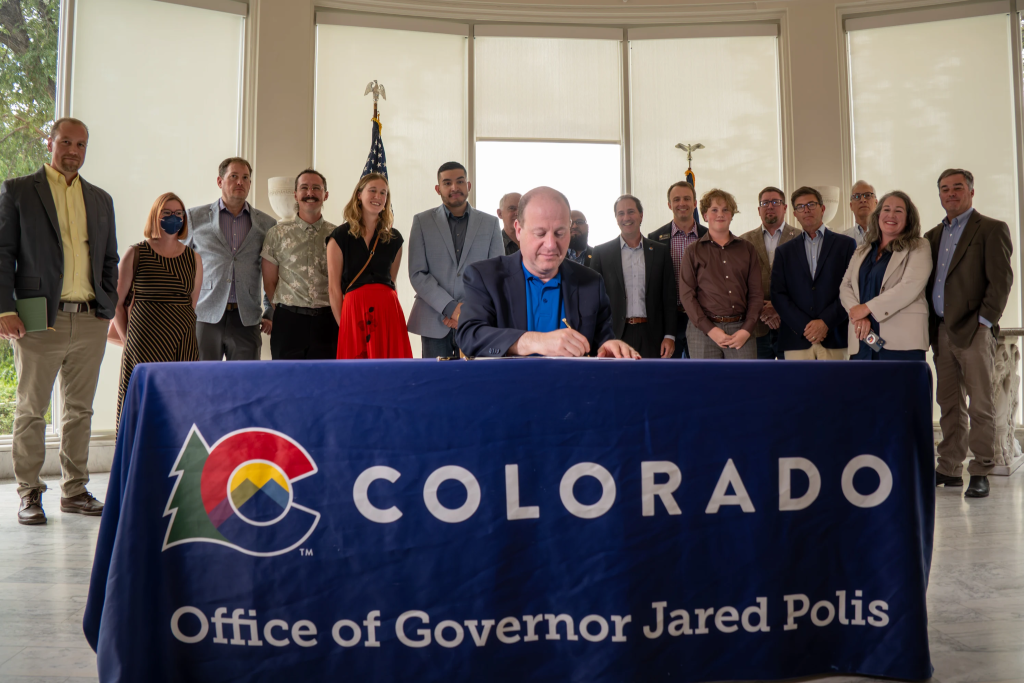
SB 142 wasn’t the only action the legislature took on geothermal. Colorado’s geothermal incentives are oversubscribed and lawmakers recognized that more can be done to scale geothermal in the state. HB 1289 expands the state’s $168 million industrial clean energy tax credit to include geothermal electricity and thermal energy networks, and allows unused credit capacity to be reallocated to geothermal projects in future years, providing more resources for geothermal to scale across the state.
Why Colorado — and why now
Colorado has something most states don’t: a geothermal resource large enough to power homes, businesses, schools, and entire communities with reliable, locally produced heat and electricity. The state has recognized this potential with substantial investment. But projects have not been happening at the pace needed to tap it.
The legal pathway has not been clear enough for developers, bond counsel, and municipal partners to act with confidence. Every hour of legal fees, every risk premium added by financing uncertainty, and every month of extended project timelines is a real cost to real projects. SB 142 fixes that.
The bill has also attracted a notably diverse coalition. Comparable geothermal legislation in Texas, HB 4370, passed the House 138-0 and the Senate 31-0. Colorado’s SB 142 now adds to that track record — passing the Senate 27-7 and the House 55-10. That is the kind of consensus geothermal tends to attract.
Extending Colorado’s geothermal leadership
Few states have done more to advance geothermal than Colorado. InnerSpace Action was proud to be part of that for SB 142 and to work with Senator Ball and the Colorado Energy Office to advance this legislation. We look forward to working with both to help enact and implement the legislation and identify future opportunities that allow Colorado to more fully tap into the over 100 GW of technical potential that the state has for geothermal electricity and the terawatts of technical potential it has for industrial heat and district heating.